
Longitudinal Ecological Tracking Through Citizen Photography
Turn your dive photos into lasting data.
Every dive holds information: what was seen, where, when and under what conditions. When logged consistently, those moments become a living record that helps researchers and local teams understand change over time.
Two ways to contribute:
- During REAL FOCUS: Submit your competition entries and contribute iNaturalist observations alongside them
- Year-round: Upload marine life observations to Solitude World iNaturalist projects
About the Study
The Solitude World Science Data Study is a structured, three-year ecological documentation initiative conducted through iNaturalist.
Led by Dr David Harasti, the study focuses on the systematic collection of baseline marine biodiversity data across Anilao, Lembeh and selected Coral Triangle locations.
This is not a short-term campaign.
It is a longitudinal effort.
The three-year structure allows seasonal and inter-annual comparison rather than isolated snapshots.
By gathering consistent observations over multiple years, the study aims to:
- Establish reliable baseline ecological data
- Document species presence across seasons and locations
- Support analysis of patterns in distribution and relative abundance over time
- Create a structured digital archive for future reference
Importantly, the purpose of this initiative is to collect data first.
Only through disciplined, repeated documentation can meaningful insights emerge.
The value of the study lies in consistency.
The findings will be shaped by what the data reveals over time.
Why it matters
Underwater life changes quietly. Some shifts happen seasonally, others over the years. A consistent record helps reveal patterns that a single trip can never show.
Your contributions support:
- better local understanding of what is present, when, and where
- stronger conservation conversations grounded in evidence
- a shared reference library that improves identification skills across the community
What data we collect
To make photos scientifically useful, we pair them with essential context. When submitting an observation, we encourage divers to include details such as:
- location (dive site or nearest known point)
- date and time
- depth
- water temperature
- notes that may help interpretation (for example moon phase, behaviour, habitat)
Small details, repeated over time, become powerful.
How to contribute
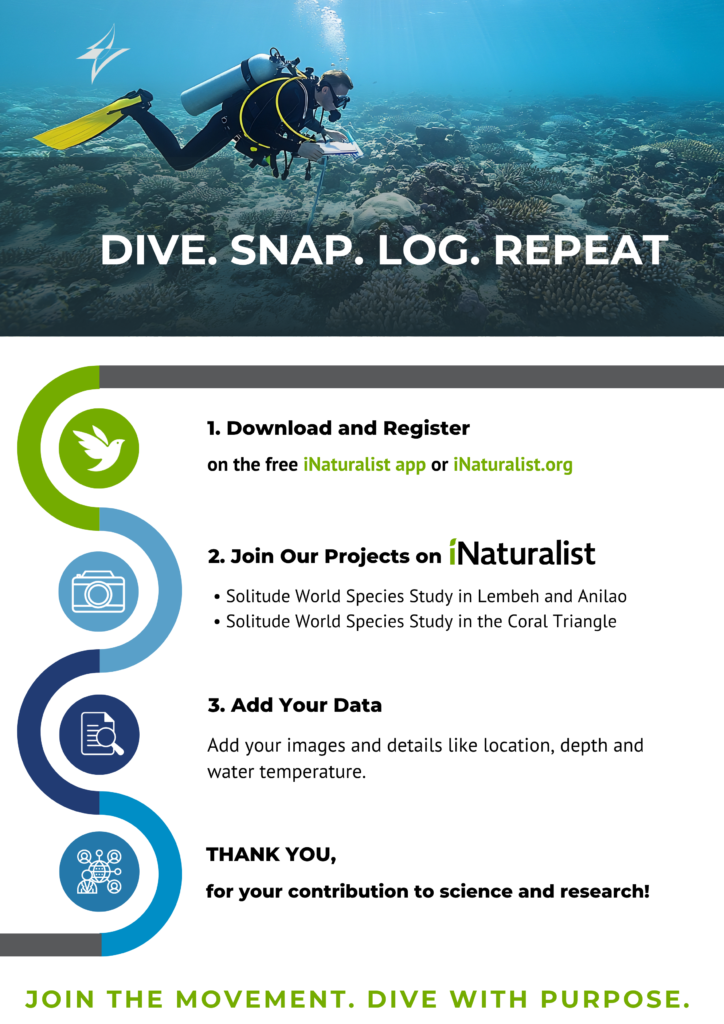
A) Year-round contribution via iNaturalist
Step 1: Download and Register
- Create a free account on the iNaturalist app or via iNaturalist.org.
- Complete your profile so your contributions are properly attributed.



Step 2: Search and Join the Solitude World projects
- Solitude World Species Study in Lembeh and Anilao
- Solitude World Species Study in the Coral Triangle
This ensures your observations feed into the correct regional datasets.
Step 3: Add Your Data
Upload your images and include:
- Location
- Date and time
- Depth
- Water temperature
- Any relevant habitat or behaviour notes
Accuracy matters more than perfection.
Step 4: Let the community help
IDs can be refined over time through a mix of AI suggestions and community review. The goal is steady improvement, not perfection on day one.
B) REAL FOCUS Contribution (During the Shootout)
REAL FOCUS bridges photography, ethics and marine research.
During the shootout, participants contribute in two parallel ways. The image is not only entered into competition. It also becomes part of a wider ecological record.
Participants are required to:
1. Submit their competition entries through the official Shootout Portal
Unedited files must be uploaded before departure in accordance with the Rules and Conditions.
2. Complete the required data fields associated with each image
Each submission must include the relevant particulars, such as location, depth, water temperature and any additional contextual information requested within the portal.
The competition may conclude.
The data remains.
By pairing imagery with accurate environmental details, each photograph moves beyond aesthetics. It becomes a documented observation that contributes to longitudinal ecological tracking.
Ethics and care underwater
This study relies on respectful observation. Prioritise buoyancy, patience and a light footprint so the act of documenting does not become the disturbance.
FAQs
Do I need to be a photographer to contribute?
No. A clear record beats a perfect image.
What if I do not know the species name?
Upload what you have. Identification can be refined later.
Is this only for the REAL FOCUS dates?
No. The iNaturalist species studies are designed for long-term contribution beyond the shootout window.