
Pygmy seahorses are among the smallest seahorses on the reef, and for many divers, spotting one for the first time is the moment macro diving clicks. These tiny fish, typically measuring between 1.4 and 2.7 cm, are masters of camouflage. Many live close to gorgonian sea fans, where their colors and shape perfectly match their host, making them extremely difficult to detect at first glance.
This guide covers everything you need: what pygmy seahorses are, the species you’re most likely to encounter, the dive sites where sightings are most reliable, and the practical tips that make the difference between swimming past one and actually seeing it.
What Is a Pygmy Seahorse?
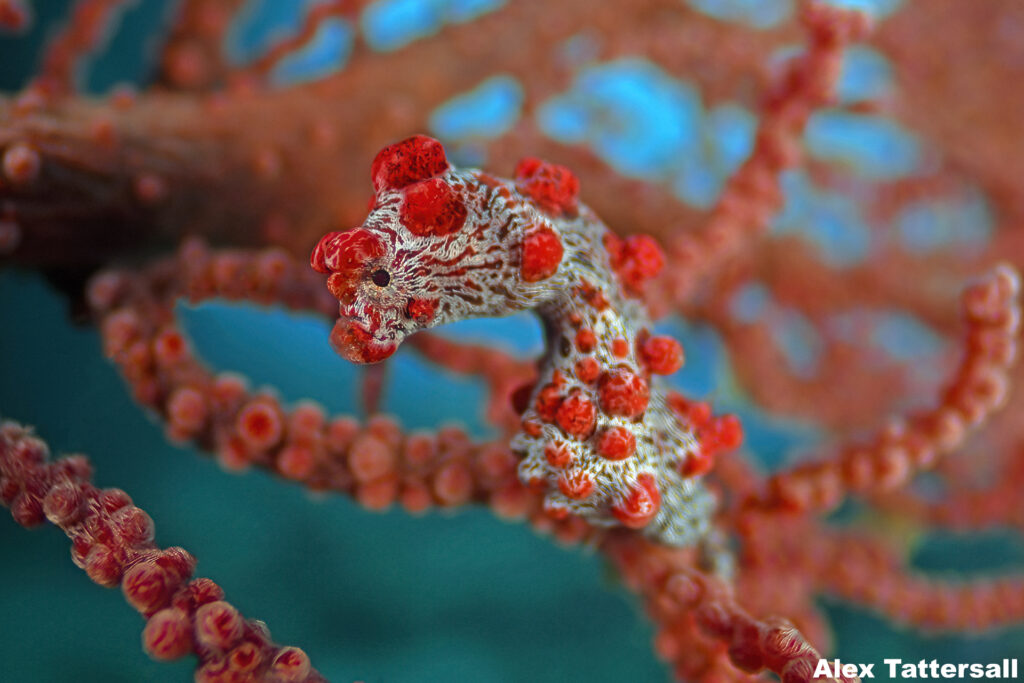
A pygmy seahorse is a small seahorse in the genus Hippocampus that spends most of its life attached to a single gorgonian sea fan. Unlike larger seahorse species, which move through open water, many pygmy seahorses anchor themselves to their host coral and rarely leave it.
Most pygmy seahorse species measure between 1.4 and 2.7 cm from snout to tail. Their bodies mimic the color, texture, and polyp structure of the sea fan so closely that, without a guide pointing one out, you can look directly at it and see nothing but coral.
Scientists have described more than nine pygmy seahorse species within the genus Hippocampus, with many found across the Coral Triangle. One of the most iconic is Hippocampus bargibanti, which lives exclusively on Muricella sea fans and is perfectly camouflaged to match its host coral.
Divers in Indonesia and the Philippines also frequently encounter Hippocampus denise (Denise’s pygmy seahorse) and Hippocampus pontohi Pontoh’s pygmy seahorse, especially in macro hotspots like Lembeh Strait and across the Philippine archipelago.
Unlike H. bargibanti (Bargibant’s pygmy seahorse), these species can be found on hydroids, algae, and reef rubble, making the region one of the best places in the world to observe pygmy seahorses in their natural habitat.
Why Pygmy Seahorses Are So Difficult to Spot
Pygmy seahorses are often locally abundant on suitable host corals, but their camouflage makes them appear rare. On the right reef, in the right depth, they are present in reasonable numbers. The difficulty is almost entirely visual.
Extreme Camouflage
Hippocampus bargibanti, the most commonly encountered pygmy seahorse species, grows small skin bumps along its body that match the polyps of its host coral in both shape and color. So, imagine a pink seahorse sitting on a pink sea fan, covered in the same rounded texture. Rather than appearing as a separate animal, it’ll most likely look like just another coral.
The match is close enough that you can be staring directly at one and still not see it. Your eye reads the whole sea fan as one surface, and the seahorse stays invisible inside it.
Minimal Movement
Pygmy seahorses grip their host coral with their tail and hold position for long stretches. They do not dart, hover, or pulse the way most reef fish do, so there is no motion to catch your eye as you scan the sea fan.
When they do move, it is slow and deliberate, a small reposition along a branch, nothing that registers as animal behavior at normal diving pace. Slowing down is not optional here. It is the only thing that works.
Size and Scale Underwater
Most people picture a seahorse the size of a hand, but pygmy seahorses are closer to the size of a fingernail. That size difference matters more than you’d expect once you’re underwater.
Getting close helps significantly. At around 20 centimetres from the coral, you have a reasonable chance of picking one out. At arm’s length, especially in any current, they simply disappear into the texture around them.
Pygmy Seahorse Habitat
Many pygmy seahorses live in close association with specific host organisms that provide camouflage and protection. Well-known species such as Bargibant’s pygmy seahorse (Hippocampus bargibanti) live exclusively on Muricella gorgonian sea fans, while Denise’s pygmy seahorse (Hippocampus denise) inhabits Annella and other gorgonians, typically between 15 and 40 metres. Some species occur much deeper, down to 90 metres or more.
Not all pygmy seahorses depend on corals. Species like Pontohi pygmy seahorse (Hippocampus pontohi) and Satomi’s pygmy seahorse (Hippocampus satomiae) live in hydroids, algae, and seagrass, often in shallower reef areas.
Regardless of the habitat, pygmy seahorses rarely move far. They anchor themselves with their tails and often remain on the same host for weeks or months, which is why experienced dive guides can reliably find them in specific locations.
Where to Find Pgymy Seahorses
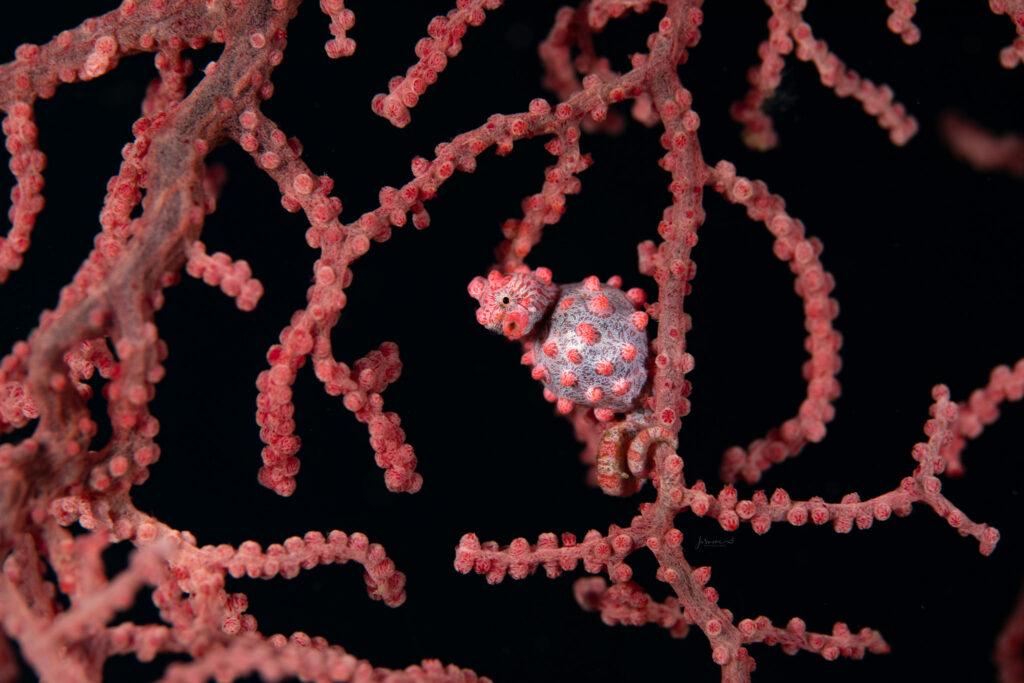
The destinations below have the suitable coral conditions and environments that make them the best places to find pygmy seahorses:
1. Indonesia
Indonesia has some of the most reliable pygmy seahorse diving in the Indo-Pacific, largely because its reefs support the gorgonian density that H. bargibanti and related species require. Lembeh Strait in North Sulawesi is often where many divers see their first one, with resident individuals documented on specific sea fans at depths of 15 to 30 metres.
Raja Ampat offers sightings across multiple reef wall sites, and Bali’s diving around Tulamben produces regular encounters for divers who spend time at depth with a guide who knows the site.
2. The Philippines
Anilao in Batangas has a long history as the Philippines’ macro diving hub, and its guides are among the most experienced pygmy seahorse spotters in the region. Further south, Tubbataha Reef in the Sulu Sea offers sightings in a more open, current-driven setting that suits divers with solid buoyancy control and some experience diving walls.
3. Palau
Palau’s steep reef walls and thriving gorgonian sea fans provide suitable habitat for pygmy seahorses, including Denise’s pygmy seahorse (Hippocampus denise), which relies on these corals for camouflage and protection.
While sightings are never guaranteed due to their exceptional camouflage, Palau’s healthy reef ecosystems and strong coral growth make it one of the few destinations in Micronesia where encountering pygmy seahorses is possible for observant divers comfortable with depth and current.
4. Papua New Guinea
Milne Bay has been on the macro diving map for a long time, with reef conditions and guide expertise that rival the Coral Triangle’s best sites. Sightings here are repeatable rather than accidental, which reflects both the reef health and the local knowledge that experienced guides bring to each dive.
5. The Maldives
The Maldives produces pygmy seahorse sightings, but they are less consistent than in the destinations above. They tend to occur on deeper reef walls where gorgonian coverage is good, and your best chance is a dedicated macro dive arranged in advance with a guide who knows where to look.
How to Spot Pgymy Seahorses

Most divers who see a pygmy seahorse for the first time describe the same experience: their guide stops, points at a sea fan, and they still cannot see it. Then something shifts, and suddenly it is obvious. Getting to that shift faster is mostly a matter of changing how you look.
Looking for Patterns, Not Animals
Scanning a sea fan quickly rarely works. What does work is looking for small irregularities, a bump that sits slightly differently, a texture that does not quite repeat, a shape that breaks the fan’s natural rhythm. Pygmy seahorses give themselves away through subtle mismatches rather than obvious features, so the more familiar you are with what healthy coral looks like, the easier they become to pick out.
This takes practice, but it gets easier with each dive. Macro divers often describe it as learning a new way of seeing, and that description is accurate.
Slowing Down
Spending five minutes on a single sea fan will almost always produce more than spending five minutes covering ground. Pygmy seahorses do not move toward you or away from you, so the only variable you can control is how carefully and how long you look.
This is one of the reasons macro diving in places like Lembeh or Anilao tends to involve shorter distances and longer bottom times. The reef gives up more when you stay still.
Should You Get a Guide to Help Spot Pygmy Seahorses?
Yes, especially on your first few attempts. Guides who dive the same sites repeatedly build up specific knowledge of which sea fans hold resident animals, knowledge that takes years of regular diving to accumulate. A good local guide does not just lead you to the right reef. They take you to a particular coral, at a particular depth, where they have seen a pygmy seahorse before.
That kind of site-specific knowledge is genuinely difficult to replicate from a dive brief or a map, and for a species this small and this well-hidden, it makes a measurable difference to whether you see one or not.
How to Observe Pygmy Seahorses Without Causing Harm
One important thing to note about pygmy seahorses is that because many of them spend their entire adult lives attached to a single coral host, their survival highly depends on this relationship.
When you encounter one, you are not just seeing a tiny fish. You are witnessing a long-established partnership between an animal and a coral that may have existed for years.
Because pygmy seahorses rarely leave their host, protecting the coral means protecting the animal.
Here’s how you can dive more responsibly without causing harm to pygmy seahorses and their environment.
Avoid Touching
Gorgonian sea fans are living animals with fragile tissue covering a flexible skeleton. Even light contact from a hand, fin, or camera can damage that tissue. While the impact from a single touch may appear minor, repeated contact over time weakens the coral, reduces its health, and can ultimately make it unsuitable as habitat.
Pygmy seahorses depend entirely on these corals for camouflage, protection, and reproduction. If the coral declines, the seahorses disappear with it.
This is why buoyancy control is essential. Responsible divers maintain complete control of their position in the water without touching the reef. If you cannot hover comfortably without stabilizing yourself, it is best to improve your buoyancy skills before attempting to photograph sensitive subjects like pygmy seahorses.
How to Photograph Pygmy Seahorses Responsibly
Underwater photography can be done safely when the animal’s welfare comes first. Research shows that diver behavior, especially close approach and physical disturbance, has a greater impact on seahorses than camera flashes themselves.
The key principles are simple:
- Maintain a respectful distance
- Avoid touching the coral or the surrounding reef
- Never manipulate the animal or its environment
- Limit your time to reduce cumulative disturbance
- Approach slowly and calmly
A relaxed pygmy seahorse will continue its natural behavior, gently adjusting its position and moving subtly along its host coral. These moments create far more compelling images than those taken under stress.
How Responsible Diving Keeps Pygmy Seahorse Sites Healthy
Healthy dive sites remain productive because the habitat remains intact. When corals are protected from damage, pygmy seahorses can continue to live, feed, and reproduce on the same hosts for years.
Conversely, repeated physical contact, poor buoyancy, and careless diver behavior gradually degrade these fragile habitats. Coral damage reduces available living space, and once lost, recovery can take many years or longer.
Every careful interaction helps preserve these animals for future divers. By maintaining good buoyancy, respecting marine life, and prioritizing the health of the reef, you contribute directly to the long-term protection of pygmy seahorses and the ecosystems they depend on.
Seeing Pygmy Seahorses with Solitude World

If finding a pygmy seahorse is on your dive list, Indonesia, the Philippines, and Palau are three of the best places in the Indo-Pacific to make that happen, and these are exactly the regions where Solitude World operates. We run liveaboards across all three, with local guides who know their sites well enough to take you to a specific coral at a specific depth where they have seen these animals before.
Our guides also know how to approach them correctly, how to position a small group without disturbing the animal, and when to call the dive so the seahorse stays relaxed for the next group that comes along.
Browse our liveaboard itineraries and resort options to find the right fit, or get in touch, and we will help you plan around the right destination and season.
What are you waiting for? Book your next diving adventure with us here today!